
Garage and shop floors that shrug off everything
Epoxy Garage Floor Coatings in Gwinnett County, GA
Coating failures are prep failures. We diamond-grind every slab, repair what is under the surface, and build the system up in coats so it stays stuck to the concrete instead of peeling off with your tires.
Mechanical diamond grind — never an acid-etch shortcut
Full flake, partial flake, metallic and solid color options
Resists hot tire pickup, road salt, oil and solvents
Polyaspartic top coats for next-day return to service
Overview
Prep decides everything
Almost every peeling garage floor in Georgia has the same story: the coating went over concrete that was acid-etched or just pressure-washed, so it never mechanically keyed into the slab. It looked perfect for a season, then a hot tire pulled a sheet of it up in July.
We do not use acid. Every floor gets mechanically diamond-ground to open the concrete profile, with HEPA dust extraction so your house does not fill with silica. Then we chase and fill cracks, rebuild spalled pits, treat control joints, and moisture-test the slab before a single drop of resin goes down.
Only then does the system get installed — primer, pigmented base, flake broadcast if specified, and a polyaspartic or urethane top coat that carries the abrasion and UV resistance. Built that way, the coating is thicker than a big-box kit by an order of magnitude and bonded to concrete rather than sitting on it.
Free estimate
Get epoxy coatings priced on site
We measure, check drainage and access, put samples on the ground, and hand you a line-item price. No cost, no sales script.
- Licensed & insured
- Free on-site estimates
- Owner on every job site
- Written workmanship warranty
Mon – Fri: 7:00 AM – 6:00 PM
Saturday: 8:00 AM – 2:00 PM
Applications
Floors we coat
Residential garages
The most requested job we do. Full flake systems with a polyaspartic top coat that handles hot tire pickup, dropped tools, road salt off winter tires and oil drips, and wipes clean with a mop.
Basements & bonus rooms
Finished basement floors, home gyms and playrooms. We moisture-test first, because a below-grade slab in Georgia can push enough vapor to lift the wrong system.
Workshops & detached shops
Higher-build systems for woodworking and mechanical shops where solvents, welding sparks, jack stands and dropped steel are part of daily life.
Commercial kitchens & breweries
Urethane cement and quartz-broadcast systems with integral coving and slip texture, built for constant water, hot cleaning and thermal shock — where a standard epoxy would not survive.
Warehouses & showrooms
Solid-color and metallic systems with line striping, safety markings and traffic zones. Fast-cure options let us work overnight or over a weekend to keep a business trading.
Patios, porches & pool decks
UV-stable polyaspartic systems with texture additives for exterior concrete, which yellow far less than epoxy in direct Georgia sun.
Your options
Coating systems & looks
The finish you choose changes the price, the cure time and how well the floor hides dirt. We bring physical samples so you can see flake blends and metallic swirls in your own garage lighting rather than on a screen.
Full flake broadcast
Vinyl chips broadcast to refusal across the whole floor, then troweled and top-coated. The most durable and most forgiving finish — it hides dust, tire marks and slab imperfections and adds a subtle texture underfoot.
Partial flake
A lighter chip broadcast over a pigmented base, so the base color still reads through. A cleaner, more contemporary look for a lower cost than full flake.
Metallic epoxy
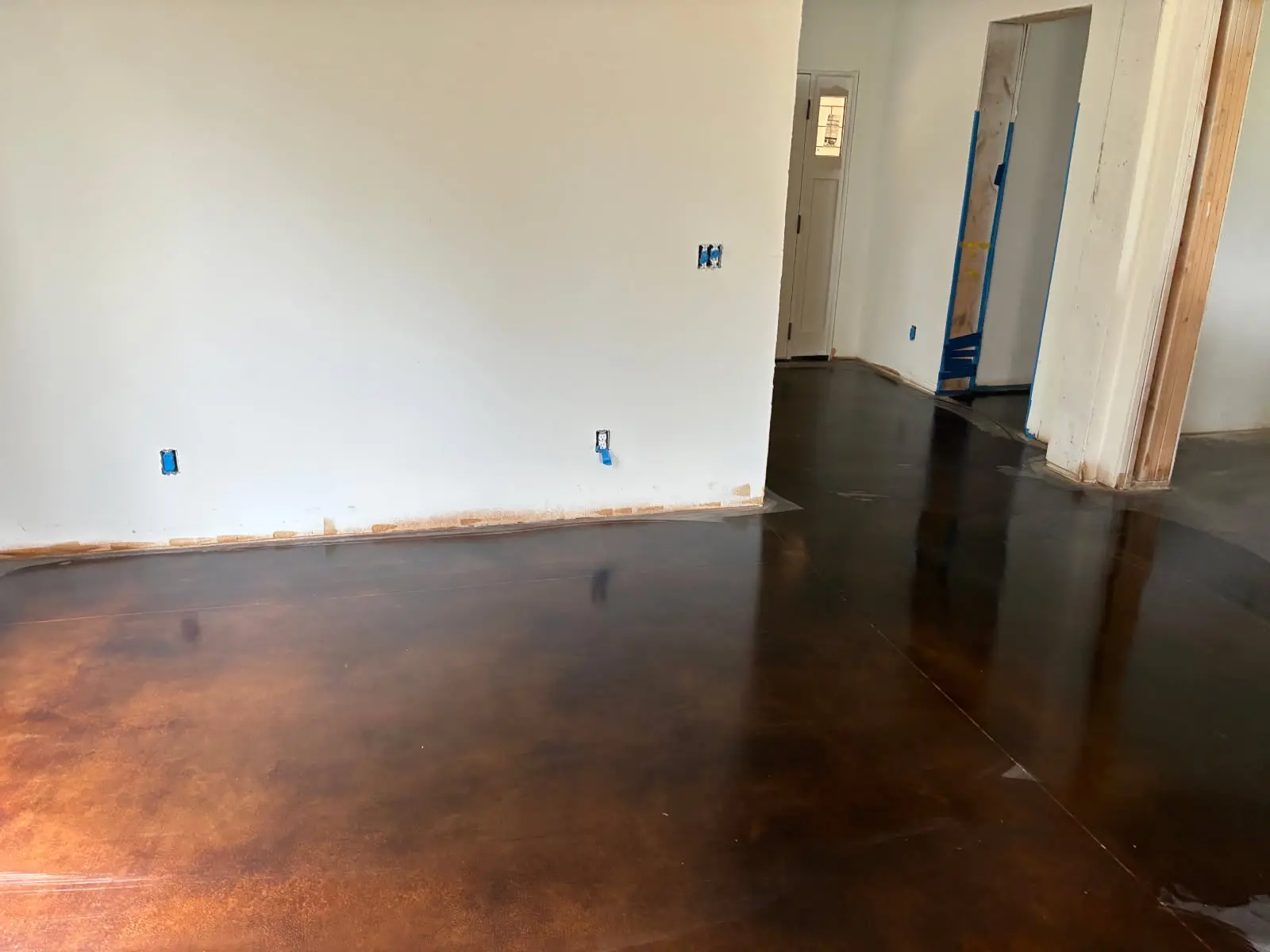
Reflective pigments manipulated while the resin is wet to create depth, marbling and movement. No two floors come out the same. Best in showrooms, basements and feature spaces rather than working garages.
Solid color
Straight pigmented epoxy with a clear top coat. The commercial standard, easy to keep clean and easy to touch up, and it takes line striping and safety markings well.
Quartz broadcast
Colored quartz sand instead of vinyl flake for a heavier, more aggressive texture. The system to specify in commercial kitchens, wash bays, locker rooms and anywhere permanently wet.
Polyaspartic top coats
UV-stable, faster-curing and more abrasion-resistant than epoxy as a wear layer. This is what lets us hand a garage back the next day and what keeps a light-colored floor from ambering in the sun.
Process
How we install a coating
Moisture test & assessment
We test the slab for vapor drive, check for existing coatings and sealers, and look at cracking and spalling. This determines the primer and whether a vapor-tolerant system is required.
Diamond grind
Mechanical grinding across the whole floor to open the concrete profile, plus hand grinding at walls and corners. Dust goes into HEPA-filtered extraction, not into your house.
Repair & joint treatment
Cracks chased out and filled, spalled pits rebuilt, and control joints treated so they either move with the floor or get filled flush, depending on the system.
Prime & base coat
Penetrating primer into the profiled slab, then the pigmented base coat rolled and back-rolled to a uniform film thickness.
Broadcast & scrape
Flake or quartz broadcast into the wet base, left to cure, then scraped and vacuumed to knock down the standing edges so the finished surface is smooth and comfortable.
Top coats & return to service
One or two clear top coats with any slip additive worked in, then a written cure schedule: when to walk it, when to park on it, and when it can take chemicals.
Local conditions
What Georgia does to garage floors
Heat and hot tire pickup are the local killers. An unconditioned garage in Lawrenceville or Johns Creek can run well over a hundred degrees in July, and tires come home from the interstate hotter than that. A thin, poorly bonded coating softens and releases where the tire sits — which is exactly the failure people describe when they call us to redo a box-store kit.
Humidity is the second problem. Georgia slabs, especially below-grade basement floors and garages built into a hillside, drive water vapor upward year-round. If nobody moisture-tests the slab and the wrong primer goes down, that vapor collects under the film and blisters it. We test first and specify a vapor-tolerant system when the numbers call for it.
Then there is the everyday grit: red clay in the tire treads, March pollen coating everything, and chloride residue from the occasional winter salt run. All three are abrasive or corrosive on bare concrete and all three simply mop off a properly top-coated floor.
Epoxy Coatings service area
Based in Lawrenceville, GA, we keep the radius tight so we can come back to check a cure, seal on the right day, or fix something years later.
Gwinnett County, GA
- Lawrenceville
- Suwanee
- Duluth
- Dacula
- Grayson
- Snellville
- Lilburn
- Buford
North Fulton, GA
- Johns Creek
- Alpharetta
- Roswell
- Milton
- Sandy Springs
Outside the list? Call (404) 670-8273 anyway — we travel for larger pours.
What an epoxy floor costs
Coatings are priced per square foot, and the two things that move the number most are how much prep the slab needs and which system you pick. A single-car garage in good condition and a spalled two-car slab with an old failed coating on it are not the same job, so we quote after seeing the floor.
- Square footage and how much hand grinding the corners, walls and steps require
- Removing a previous coating, sealer, paint or mastic before grinding
- Crack, pit and spall repair, plus control joint treatment
- System choice — partial flake, full flake, metallic or quartz broadcast
- Whether slab moisture requires a vapor-tolerant primer
- Number of top coats, slip additive, cove base and any line striping
Keeping a coated floor tight
We hand this over in writing at the walkthrough, along with the cure and sealing schedule for your specific job.
- Dust mop or blow it out weekly; grit under tires is what wears a top coat.
- Mop with a mild pH-neutral cleaner. Skip citrus and pine solvent cleaners, which soften some resins.
- Wipe brake fluid, battery acid and paint stripper promptly — those are the few chemicals that will mark a coating.
- Use furniture pads under toolboxes and jack stands, and lay a mat under a welding station.
- Rinse road salt off in winter rather than letting it dry on the surface.
Our work
Epoxy Coatings projects we've finished
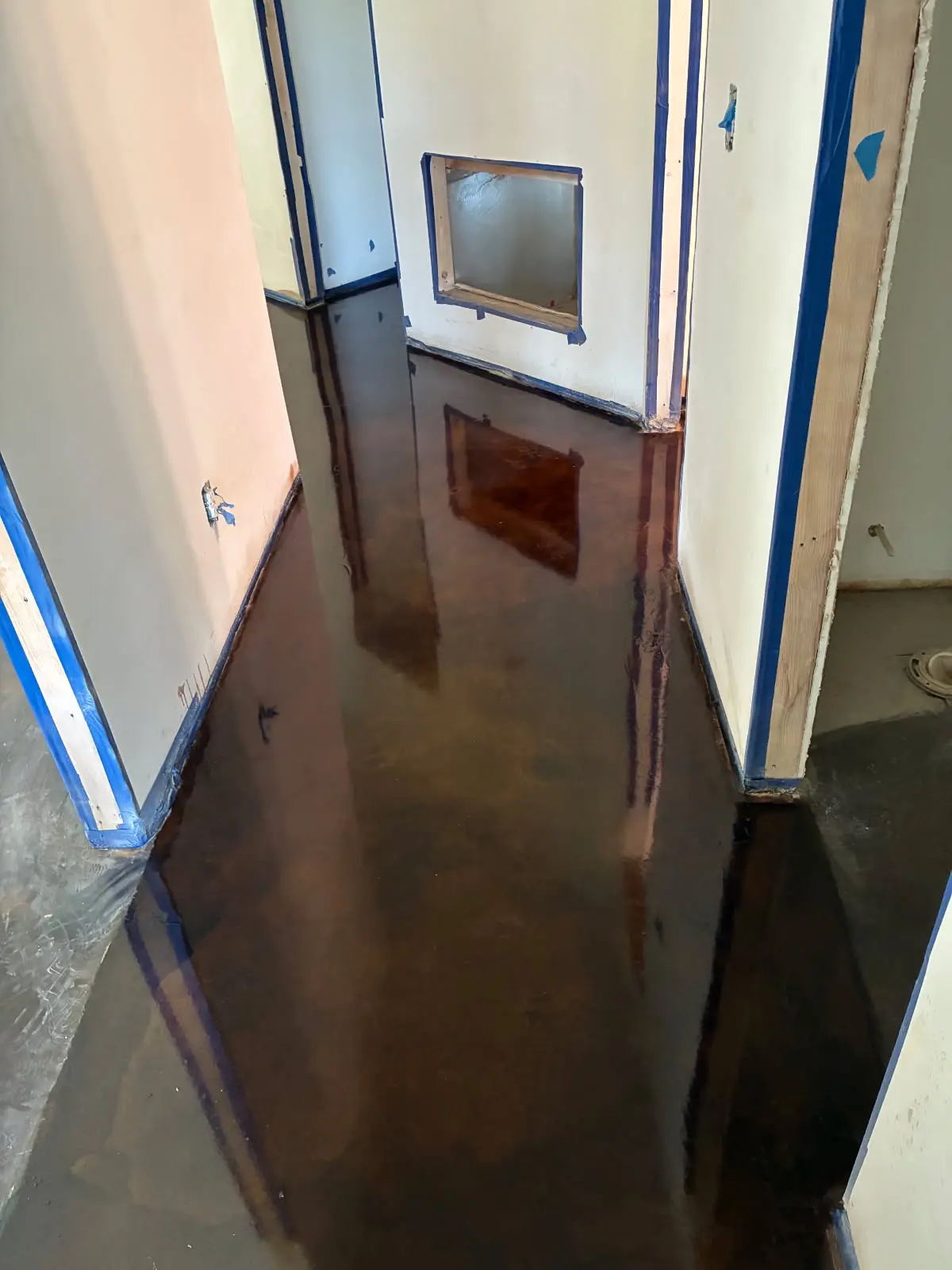
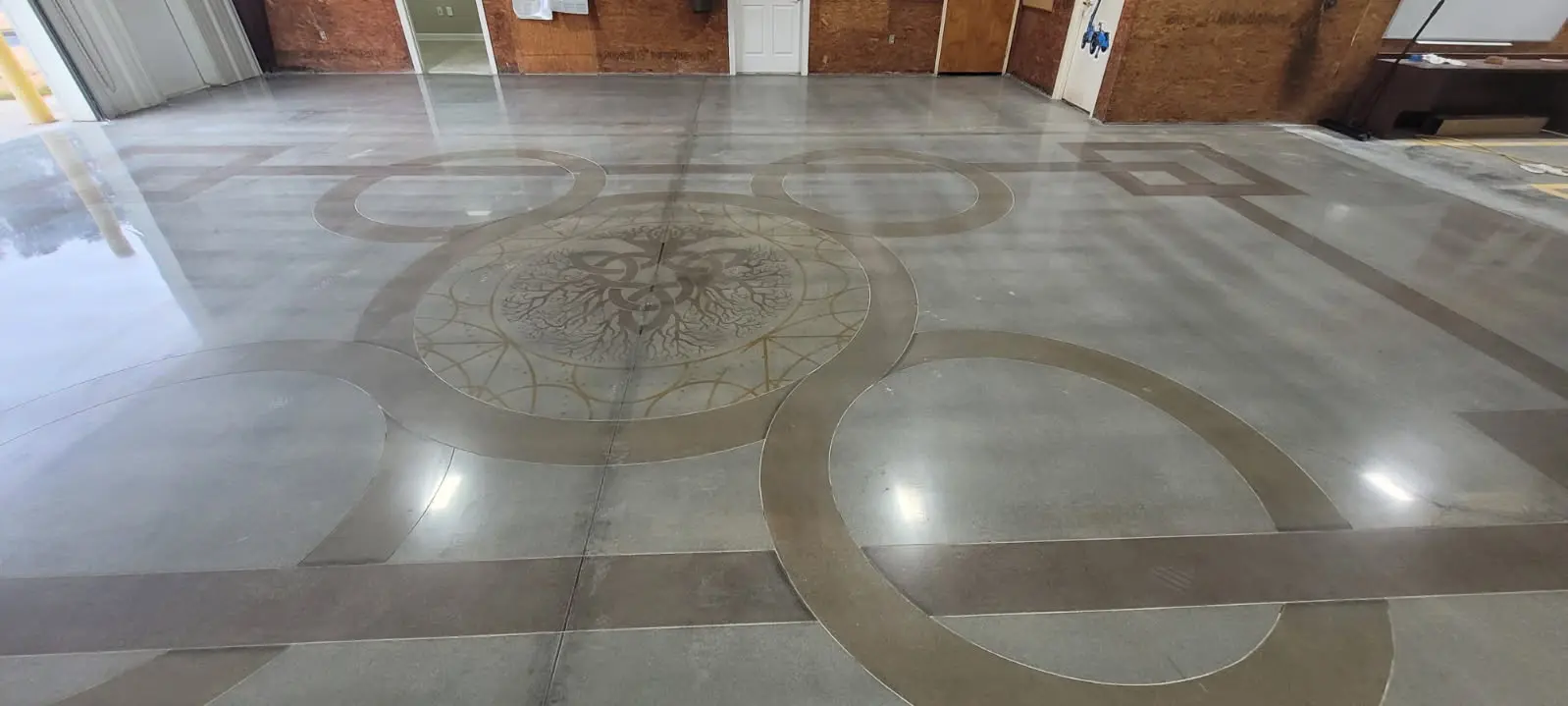
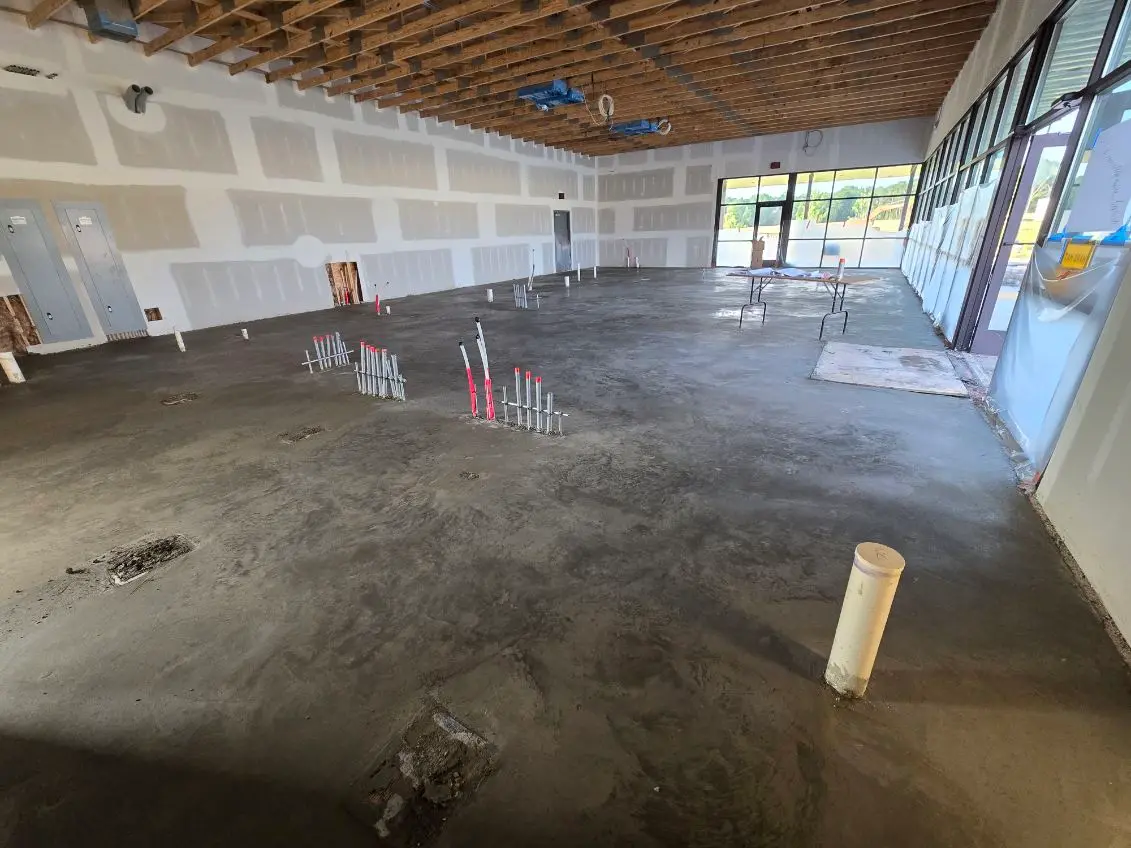
Every photo is our own crew's work across Gwinnett County and North Fulton.
Before you ask
Epoxy Coatings questions
Something not covered here? Call (404) 670-8273 — you'll get a person who actually pours concrete, not a call center.
Why did my last epoxy floor peel?
Nine times out of ten, prep. Acid etching or pressure washing does not create the concrete profile a coating needs to key into, so the film is only stuck to the surface paste. Add a hot tire and it lifts. The other common causes are untested slab moisture blistering the film from underneath and a coating installed too thin. Grinding, testing and correct film build fix all three.
What is the difference between epoxy and polyaspartic?
Epoxy is a thick, high-build resin that does the body of the system — it fills, bonds and carries the color. Polyaspartic cures much faster, resists abrasion better and is UV-stable, so it does not amber in sunlight. The best systems use both: epoxy as the base, polyaspartic as the wear layer. Polyaspartic-only systems are also what make a one-day install possible.
How long before I can park on it?
With a polyaspartic top coat, light foot traffic is usually same day or next morning and vehicles typically go back after about 24 to 48 hours. Straight epoxy systems want longer — often three to five days before tires. Full chemical resistance takes about a week either way. You get the exact schedule for your system in writing before we start.
Can you coat a floor with cracks or spalling?
Yes, and repairing them is part of the job rather than an add-on surprise. Cracks get chased out and filled with a rigid or semi-rigid repair material depending on whether they are moving, and spalled pits are rebuilt and ground flush. What we cannot coat over is a slab that is actively heaving or has failed sub-grade — a coating will not bridge structural movement.
Do you install epoxy in winter?
Yes. Georgia winters are mild enough for most of the season, and we use products formulated for lower temperatures when needed. What matters is slab temperature and dew point rather than the air temperature on the forecast — resin applied to a slab near dew point will haze or blush. We check both on the morning of the install.
Is a flake floor slippery when it is wet?
Flake broadcast adds real texture, so a full flake floor already has decent wet traction. Where a floor gets consistently wet — commercial kitchens, wash bays, pool surrounds — we go further and add a polymer or aluminum oxide grit to the top coat, or specify a quartz broadcast system for a deliberately aggressive texture.
Also worth a look
Related services
Epoxy Coatings often gets paired with these on the same site visit — and we price them together so nothing gets poured twice.
Polished Concrete
Diamond-ground, densified and burnished to satin, semi-gloss or mirror. Stains, dyes and custom inlays available.
View serviceConcrete Overlays
Bond a stampable or stained overlay over sound existing concrete — new finish, no demolition.
View serviceTraditional Concrete
Driveways, patios, slabs and sidewalks with compacted sub-base, real reinforcement and a clean broom finish.
View service
Free estimate
Let's pour something you'll be proud of.
Send us a few details about your driveway, patio or floor and we'll come measure it, price it, and show you finish samples — free, with no pressure.
Start your project