
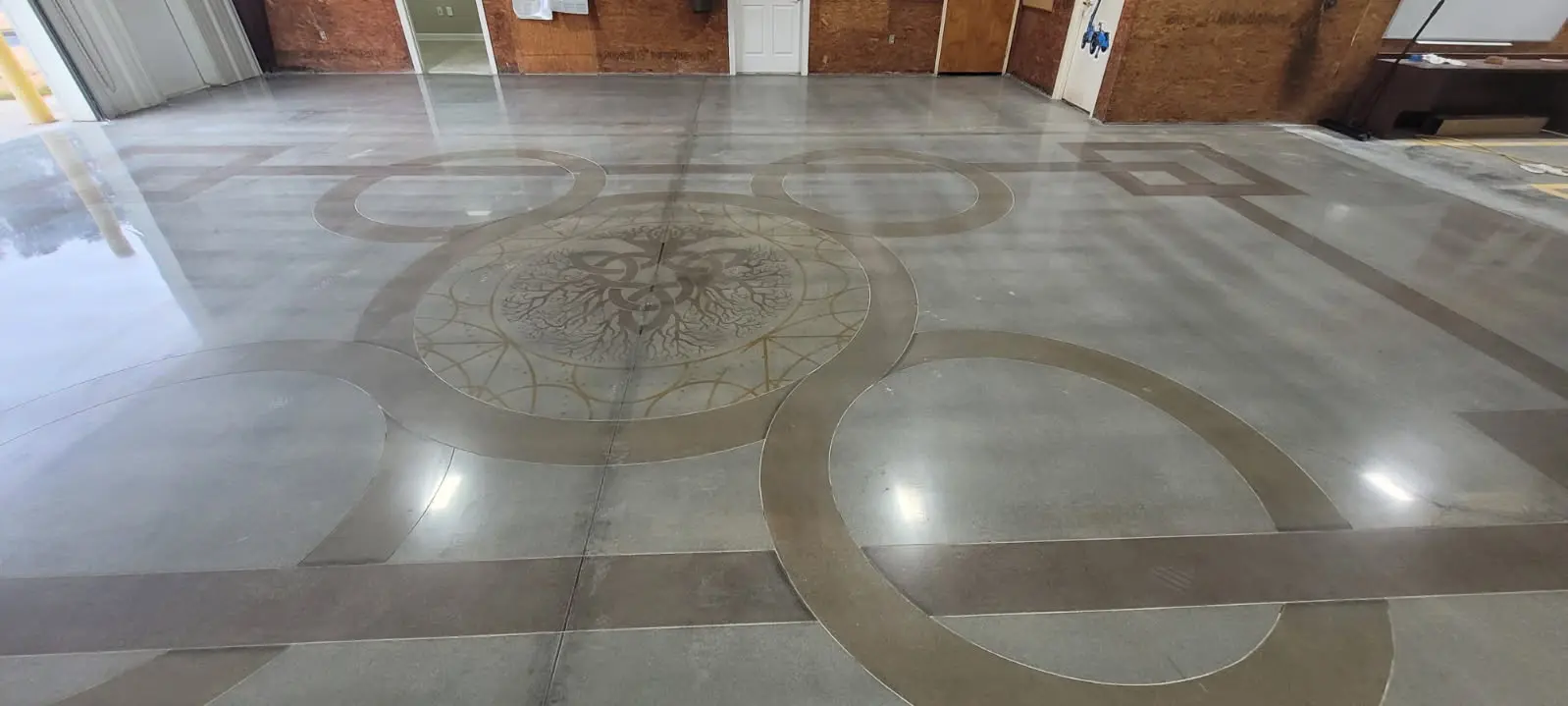
A finished floor hiding under your slab
Polished Concrete Floors in Metro Atlanta, GA
Not a coating and not a wax. We grind the slab you already own through progressive diamonds, harden it chemically, and burnish it until the concrete itself is the finished floor.
Satin to mirror gloss levels, your call
Acid stains, dyes, logos and geometric inlays
No wax, no coatings to peel — the finish is the slab
Dust-controlled grinding on occupied interiors
Overview
The floor is already there
Polished concrete is a mechanical process, not a product you roll on. We run progressive diamond tooling across the slab — coarse metal-bond segments first to open the surface and flatten it, then finer resin grits in sequence — with a chemical densifier applied mid-sequence that reacts inside the concrete to harden it. Each pass closes the surface further until the slab reflects light on its own.
That is why polished concrete behaves differently from an epoxy or a wax. There is no film sitting on top to peel, blister, chip at the doorways or delaminate where a forklift turns. The shine is ground into the material. It gets refreshed rather than stripped and replaced.
We polish residential floors, basements, showrooms, restaurants, breweries, offices and warehouse slabs across Lawrenceville, Duluth, Suwanee, Johns Creek, Alpharetta, Roswell, Sandy Springs and into Atlanta proper — on new slabs and on floors that have been under carpet, tile or VCT for twenty years.
Free estimate
Get polished concrete priced on site
We measure, check drainage and access, put samples on the ground, and hand you a line-item price. No cost, no sales script.
- Licensed & insured
- Free on-site estimates
- Owner on every job site
- Written workmanship warranty
Mon – Fri: 7:00 AM – 6:00 PM
Saturday: 8:00 AM – 2:00 PM
Applications
Where polished concrete works
Basements & lower levels
Below-grade slabs are where polished concrete beats every alternative in Georgia — no organic material to hold moisture, nothing for mold to feed on, and no flooring to throw away after a water heater fails.
Retail showrooms & storefronts
Bright, hard, easy to clean, and it takes cart and foot traffic without wear paths. Higher gloss levels bounce light around the space and cut the lighting load.
Restaurants, breweries & taprooms
Dining rooms and taproom floors that handle spills, dropped glassware and constant mopping. Kitchens and wet areas usually get a quartz-broadcast coating instead — we will tell you which zones want which.
Warehouses & light industrial
Densified, polished slabs reduce dusting from the surface, make forklift traffic quieter and easier to sweep, and hold up better than a coating at dock doors and turning points.
Offices & studios
Open-plan offices, gyms, salons and studios where the exposed-slab look is the design intent, with saw-cut layouts and dyed accent zones defining the space.
Living areas & kitchens
Whole-floor residential polish on new builds and renovations. Radiant-friendly, allergen-free, and there is no grout line anywhere in the house to scrub.
Your options
Gloss, aggregate & color
Three separate decisions shape how a polished floor looks: how much you shine it, how deep we grind into the aggregate, and what color goes in. They are independent, and we bring test panels so you choose on your own slab under your own lighting.
Gloss levels
Ground and sealed matte for a raw, industrial read; satin for low-glare living spaces; semi-gloss as the common commercial specification; and full mirror polish where you want the floor to reflect the ceiling.
Cream finish
The shallowest cut. We stay in the top surface paste, so almost no stone shows and the floor reads as a smooth, even field of color. Requires a flat, well-finished slab to begin with.
Salt & pepper
Grind slightly deeper to expose the fine sand and small aggregate. The most forgiving and most requested exposure — it hides minor slab variation and reads consistent across a big floor.
Full aggregate exposure
Cut deep enough to reveal the large stone, giving a terrazzo-like look. Dramatic, and dependent on what the ready-mix supplier actually put in your slab, so we test-grind before we promise it.
Dyes & acid stains
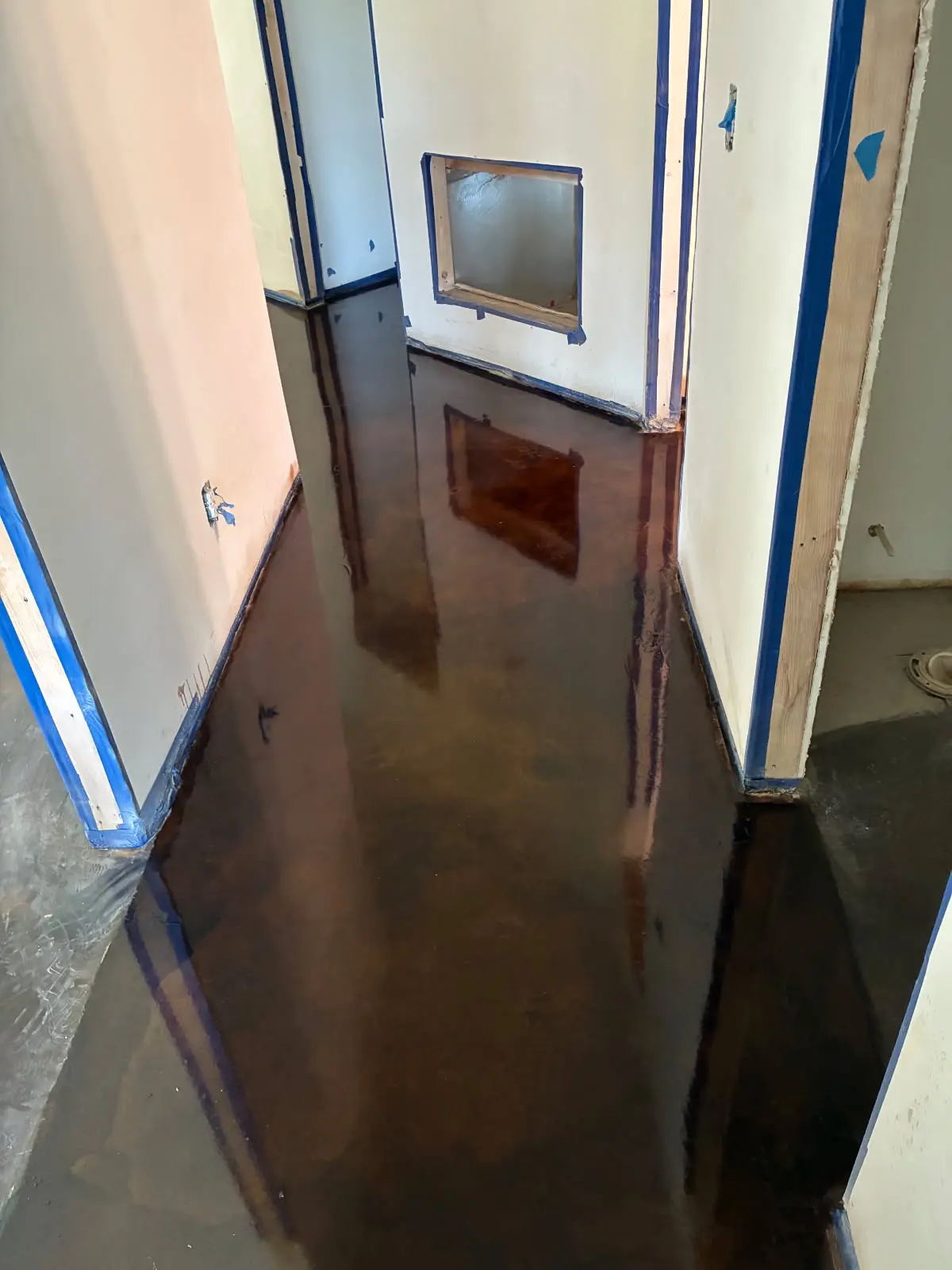
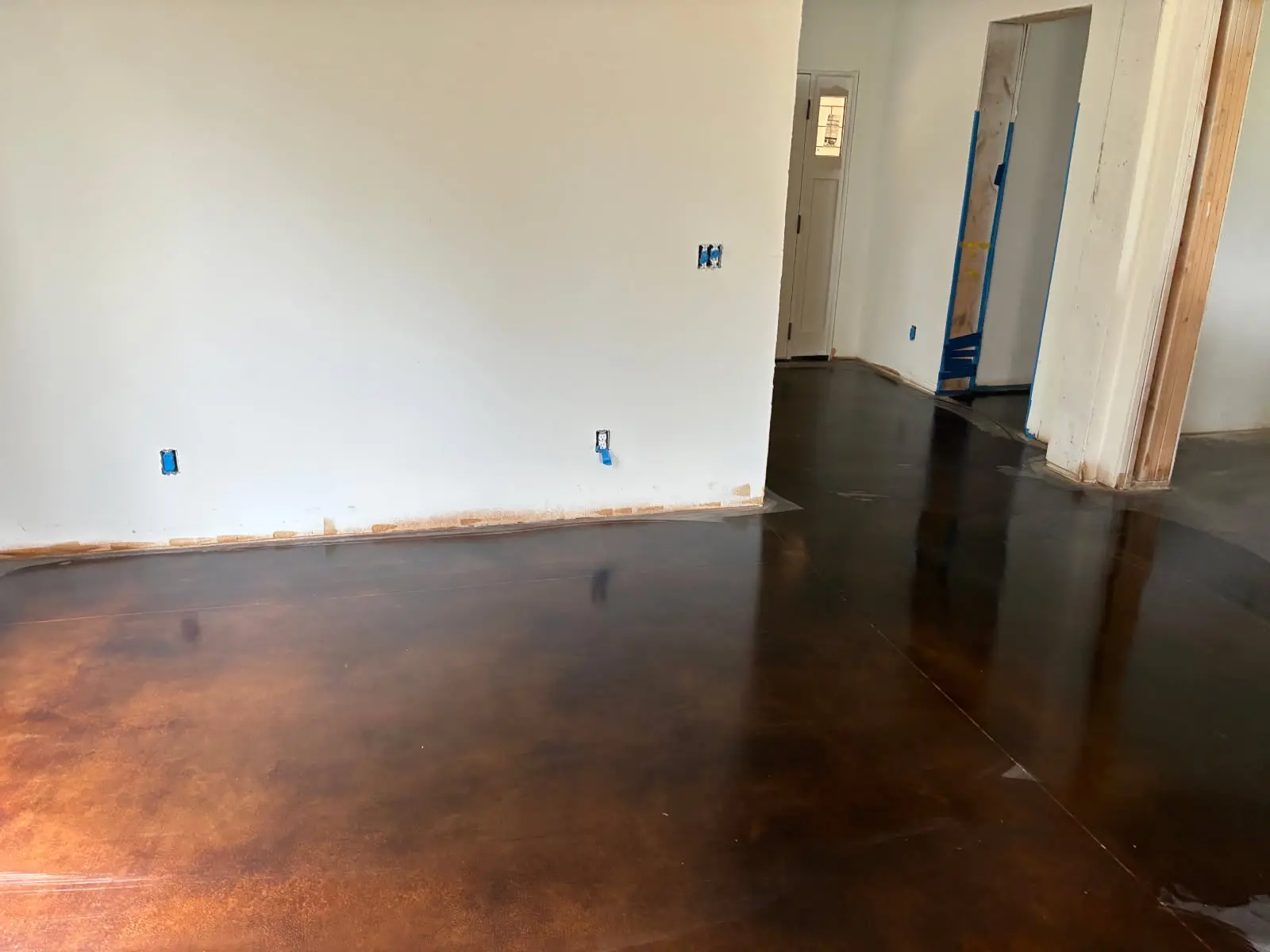
Penetrating dyes for saturated, uniform, repeatable color, or reactive acid stains for mottled, variegated, one-of-a-kind tones. Both go in mid-polish so the color lives inside the surface.
Logos, bands & inlays
Saw-cut borders, geometric layouts, stained medallions and company logos cut and colored into the floor. Common in showrooms, lobbies and taprooms where the floor is doing branding work.
Process
The polishing sequence
Slab assessment & moisture test
We check hardness, flatness, existing coatings and slab moisture, and grind a test patch so you can see the actual aggregate before committing to an exposure level.
Removal & repair
Old carpet glue, tile mortar, VCT mastic and coatings come off first. Then cracks, holes and joints get filled with semi-rigid material so they polish flat with the field.
Metal-bond grinding
Coarse diamonds flatten the slab and remove the surface layer, working up through grits. This stage sets the aggregate exposure and does most of the flattening.
Densify
A lithium or sodium silicate densifier is applied and worked in. It reacts with free lime in the concrete to harden the surface from within, which is what makes the higher grits able to hold a shine.
Color & resin polish
Dye or stain applied if specified, then progressive resin-bond grits — each one closing the surface tighter — until we hit the gloss level you selected.
Guard & burnish
A stain-resistant impregnating guard is applied and burnished in with a high-speed machine. Then we walk the floor with you under the room's own lighting.
Local conditions
Why polish holds up in the Georgia climate
Georgia humidity is brutal on flooring that sits on top of a slab. Vapor drives up through concrete year-round here, and it is the reason glued-down vinyl lets go, wood cups, and thick coatings blister and lift in Atlanta basements. Polished concrete has no membrane to trap that moisture — the slab breathes and the finish is the slab.
That makes it the strongest option for below-grade and slab-on-grade spaces across the north metro, where a summer storm, a failed supply line or a backed-up condensate drain would total carpet or laminate. A polished floor gets mopped and it is done.
Local dirt matters too. Red clay tracked in on shoes and pollen coming in every March are abrasive, and grit underfoot is what dulls a floor over time. A guard coat plus walk-off mats at entries handles almost all of it. We also run dust-extraction on every grinder with HEPA-filtered vacuums, which is what allows us to work inside occupied Atlanta storefronts and finished homes without shutting the space down.
Polished Concrete service area
Based in Lawrenceville, GA, we keep the radius tight so we can come back to check a cure, seal on the right day, or fix something years later.
Gwinnett County, GA
- Lawrenceville
- Suwanee
- Duluth
- Dacula
- Grayson
- Snellville
- Lilburn
- Buford
North Fulton, GA
- Johns Creek
- Alpharetta
- Roswell
- Milton
- Sandy Springs
Outside the list? Call (404) 670-8273 anyway — we travel for larger pours.
What polished concrete costs
Pricing tracks the amount of grinding required and the finish level specified — a warehouse slab polished to semi-gloss is a very different job from a dyed, mirror-polished showroom floor with cut-in logos. We quote by the square foot after we have seen the slab, because the slab is the variable.
- Square footage and how open the space is — small rooms and heavy furniture mean more hand edge work
- Removing existing carpet glue, tile mortar, mastic or coatings before we can grind
- How deep an aggregate exposure you want and how flat the existing slab is
- Target gloss level, since each additional resin grit is another pass over the whole floor
- Crack and joint repair, patching and any spalled areas that need rebuilding
- Dye or stain work, saw-cut layouts, inlays and logos
Living with a polished floor
We hand this over in writing at the walkthrough, along with the cure and sealing schedule for your specific job.
- Dust mop regularly — grit is the only thing that meaningfully abrades a polished surface.
- Wet mop with a pH-neutral cleaner. Skip vinegar, citrus and acidic bathroom cleaners, which etch the surface.
- Wipe wine, citrus juice, coffee and pet accidents reasonably promptly; the guard buys time, not immunity.
- Put walk-off mats at every exterior door to catch clay and pollen.
- Re-burnish and re-guard high-traffic areas every few years instead of stripping and recoating.
Our work
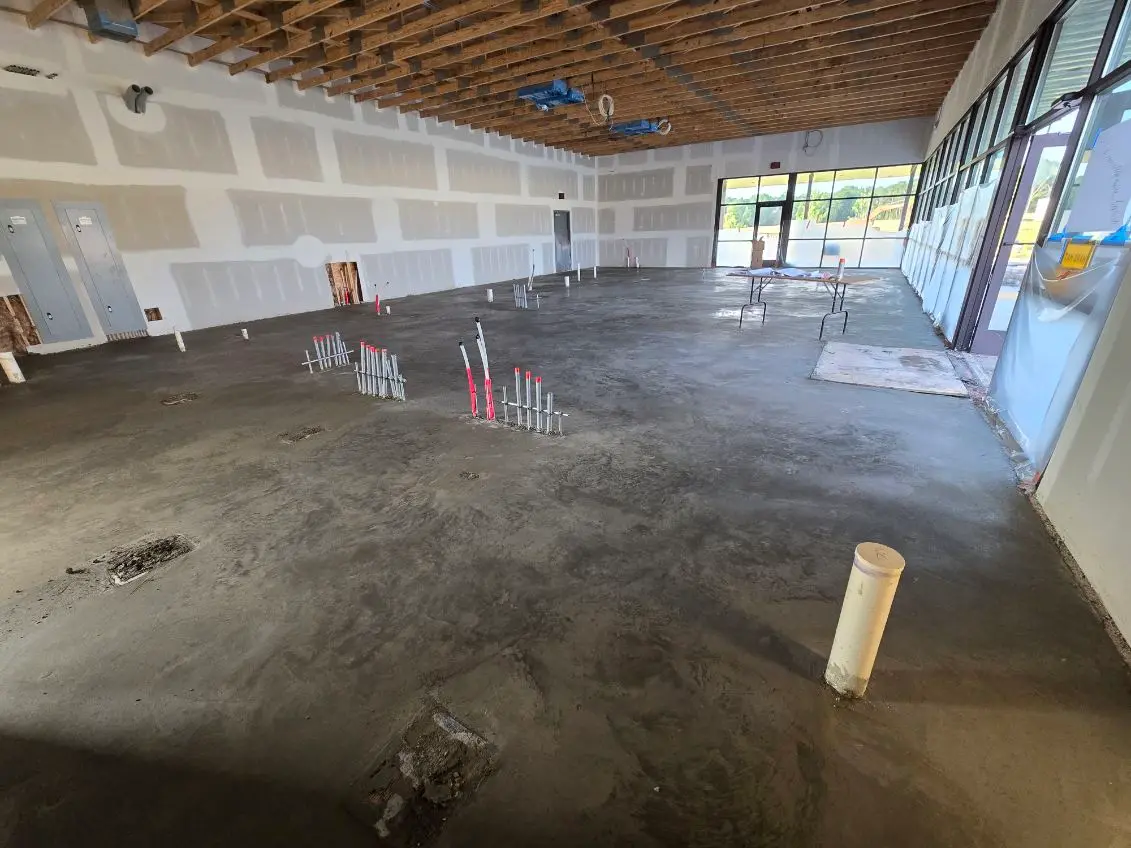
Polished Concrete projects we've finished
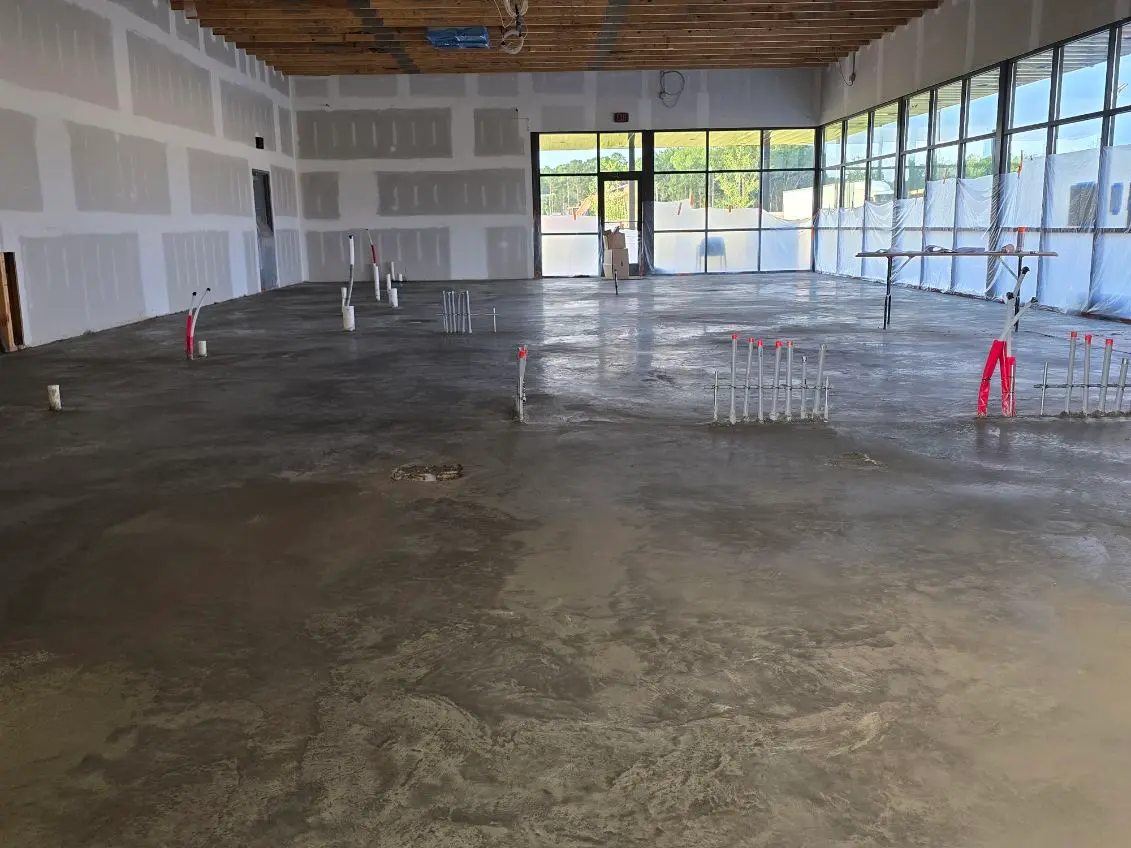
Every photo is our own crew's work across Gwinnett County and North Fulton.
Before you ask
Polished Concrete questions
Something not covered here? Call (404) 670-8273 — you'll get a person who actually pours concrete, not a call center.
What is the difference between polished concrete and epoxy?
Polished concrete is the slab itself, ground and hardened, with no film on top. Epoxy is a coating bonded to the surface. Polish cannot peel or blister and is the better answer where slab moisture is a factor or where you want the concrete look. Epoxy gives you unlimited color, full chemical resistance and a seamless waterproof film, which is what a garage, a commercial kitchen or a shop floor usually needs.
Can any concrete slab be polished?
Most can, but the slab dictates the outcome. Very soft or weak concrete will not take a high gloss. Badly out-of-level floors need more aggressive grinding or a topping first. And whether you can get full aggregate exposure depends on what stone is actually in your slab and how deep the rebar sits. We grind a test patch during the estimate so nobody is guessing.
Is polished concrete slippery?
A clean polished floor is no more slippery than polished stone or sealed tile — the coefficient of friction is comparable dry. Water on any hard, glossy surface is what creates risk, so in commercial settings we specify a lower gloss level or add a traction-enhancing treatment for wet-prone zones, and we always recommend mats at entries.
How long does the job take and how disruptive is it?
A typical residential floor or small commercial space runs two to five days depending on square footage, removal work and how many grit passes the specified gloss requires. Every machine we run is on HEPA dust extraction, so occupied spaces stay workable. We can also phase larger commercial floors by section to keep a business open.
Does polished concrete need to be sealed or waxed?
No wax, ever. The densifier hardens the concrete internally and an impregnating guard is burnished into the surface to resist staining. That guard is refreshed periodically — a maintenance step measured in hours, not a strip-and-recoat project.
Will it feel cold and loud?
It is a hard surface, so yes to both compared with carpet — although it pairs extremely well with radiant heat and holds temperature nicely in a conditioned Georgia house. Rugs in seating areas and soft furnishings solve the acoustics. In commercial spaces we sometimes recommend a lower gloss and acoustic ceiling treatment for the same reason.
Also worth a look
Related services
Polished Concrete often gets paired with these on the same site visit — and we price them together so nothing gets poured twice.
Epoxy Coatings
Flake, metallic and solid-color epoxy systems over diamond-ground, properly prepped slabs.
View serviceConcrete Overlays
Bond a stampable or stained overlay over sound existing concrete — new finish, no demolition.
View serviceTraditional Concrete
Driveways, patios, slabs and sidewalks with compacted sub-base, real reinforcement and a clean broom finish.
View service
Free estimate
Let's pour something you'll be proud of.
Send us a few details about your driveway, patio or floor and we'll come measure it, price it, and show you finish samples — free, with no pressure.
Start your project